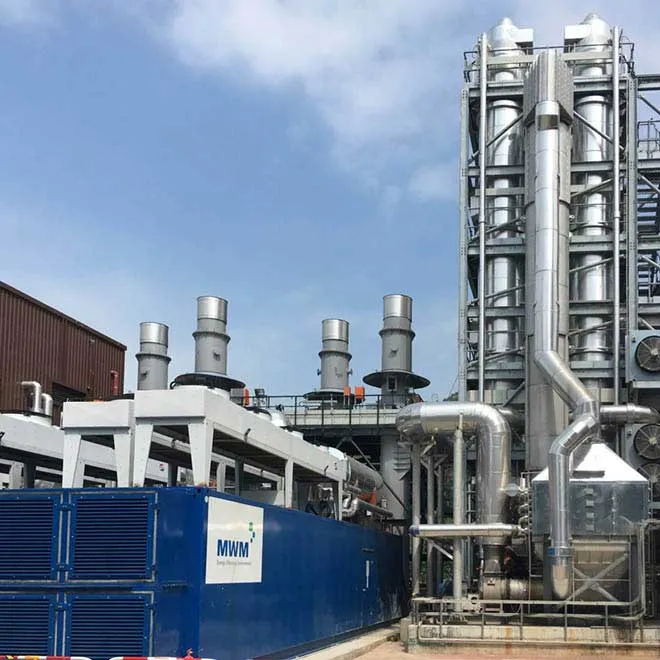
Thermal ammonia stripping is not a new concept — but OTAR’s modular integration of stripping, absorption and heat management represents a step-change in efficiency, reliability and commercial yield.
The chemistry behind OTAR is elegant: shift the pH-temperature equilibrium to release ammonia from solution as a gas, then capture it as a product. The engineering is where OTAR’s 20+ years of experience creates competitive advantage.
The Chemistry in Plain English
Ammonia exists in water in two forms:
ionised ammonium ion (NH₄⁺) and free ammonia gas (NH₃).
The equilibrium between the two is governed by temperature and pH. At low temperature and low pH, almost all ammonia is ionised and remains in solution. However, as temperature rises and/or pH increases above 9, the equilibrium shifts strongly towards free ammonia. Therefore, the free ammonia can then be driven out of solution into the gas phase. OTAR exploits this relationship using thermal energy as the primary driving force.
The Stripping Column
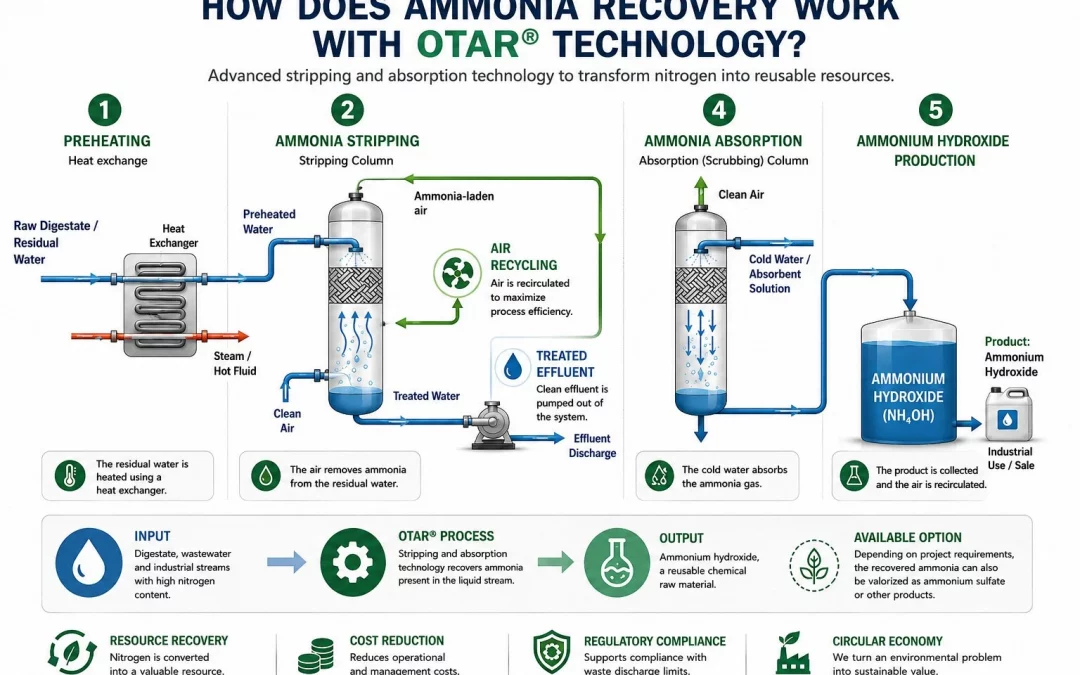
In OTAR’s stripping column, the ammonia-laden liquid is distributed over structured packing that maximises liquid-gas contact area. As a result, steam or hot air passes counter-currently through the column. Free ammonia transfers from the liquid phase to the gas phase and exits with the steam or airstream at the column top. The treated liquid exits at the base with dramatically reduced TAN. The reduction typically ranges between 85–99% removal efficiency depending on configuration, influent concentration and target consent standard.
Energy Source: Waste Heat or Heat Recycling
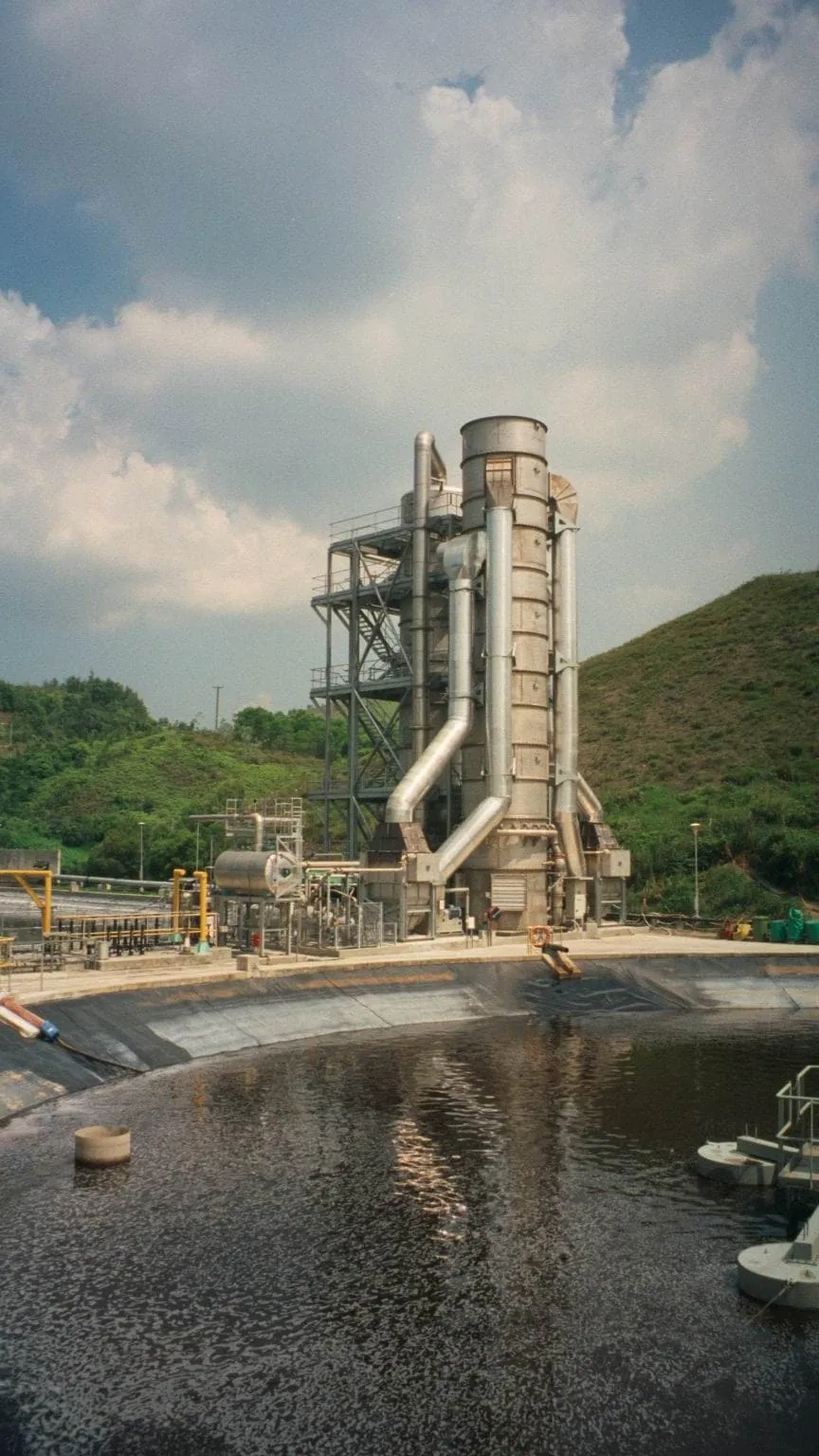
What distinguishes OTAR from conventional ambient-temperature air stripping is its thermal drive. Industrial facilities produce surplus heat from biogas engines, process cooling, incinerators or other sources. OTAR captures this energy to heat the incoming liquid, shifting the ammonia equilibrium and dramatically increasing stripping efficiency. Alternatively, where waste heat is unavailable, Variant 4’s heat recycling system uses electricity and steam compression to achieve the same thermal conditions with a coefficient of performance exceeding 15.
The Absorption Stage: Converting Gas to Product
The ammonia-rich gas leaving the stripping column is directed to the absorption stage, where it is converted into the target product. Variant 2 (the preferred recovery route) absorbs the gas into clean water. In that variant, no acid required. Therefore, it will producing high-purity ammonium hydroxide. For Variant 3, the gas instead contacts sulphuric acid to produce ammonium sulphate, while Variant 1 skips absorption altogether, sending the gas for thermal destruction. This modular absorption stage is what makes OTAR a platform rather than a fixed-function device.
Why Thermal Drive Matters for Product Quality
Because OTAR uses heat to drive the equilibrium rather than pH chemicals as the sole mechanism, Variant 2’s water absorption stage produces ammonium hydroxide. There is no contaminants associated with high-dose alkali treatment. The result is a cleaner product, suitable for sensitive end markets including OMRI-certified organic agriculture and industrial chemical applications. Consequently, this is a quality advantage that purely pH-driven systems cannot match.
The OTAR Approach
OTAR (Organics Thermal Ammonia Recovery)
OTAR is a modular platform with over 20 years of operational experience and proven installations in Asia. For operators currently spending on biological nitrogen removal, the most commercially attractive configuration is Variant 2. Which is the water absorption that converts a treatment cost into ammonium hydroxide revenue with no acid supply chain, no salt production and no hazardous chemical handling. Where waste heat is unavailable, Variant 4’s heat recycling system achieves a coefficient of performance exceeding 15, making thermal stripping viable even from cold electricity.