
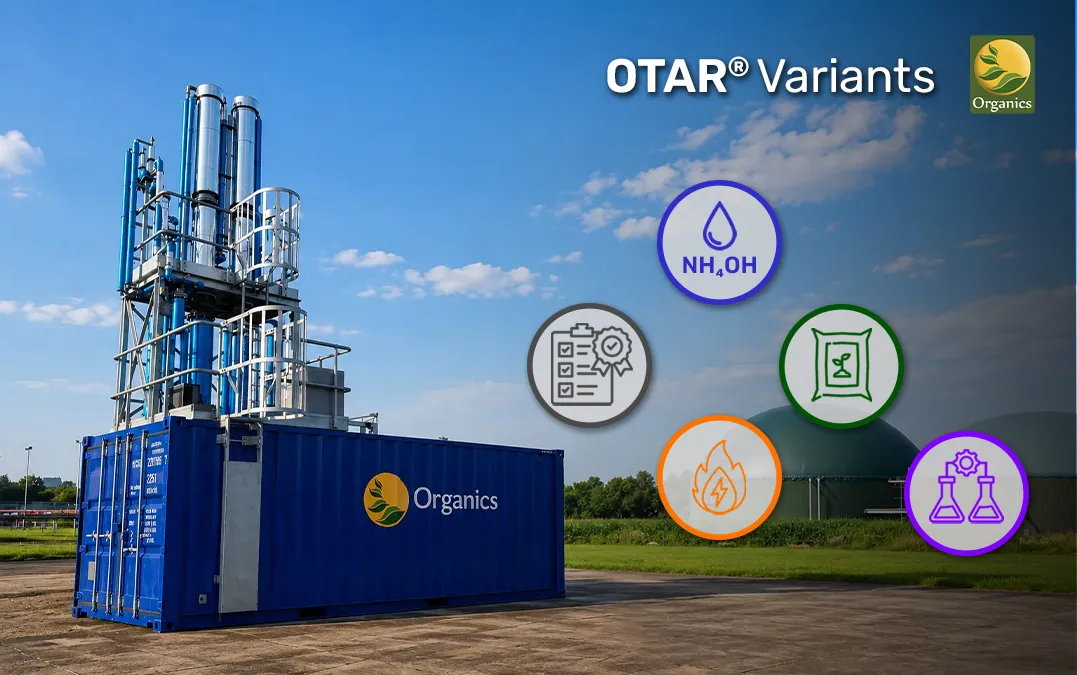
With over 20 years of operational experience and proven installations across Asia, OTAR’s five-variant architecture means there is a configuration for every site, regardless of waste heat availability, ammonia load or product market access
Understanding OTAR starts with understanding its modularity. Unlike single-purpose ammonia treatment systems, OTAR is a platform that adapts to site conditions — not the other way around.
Variant 1
Waste Heat with Thermal Destruction
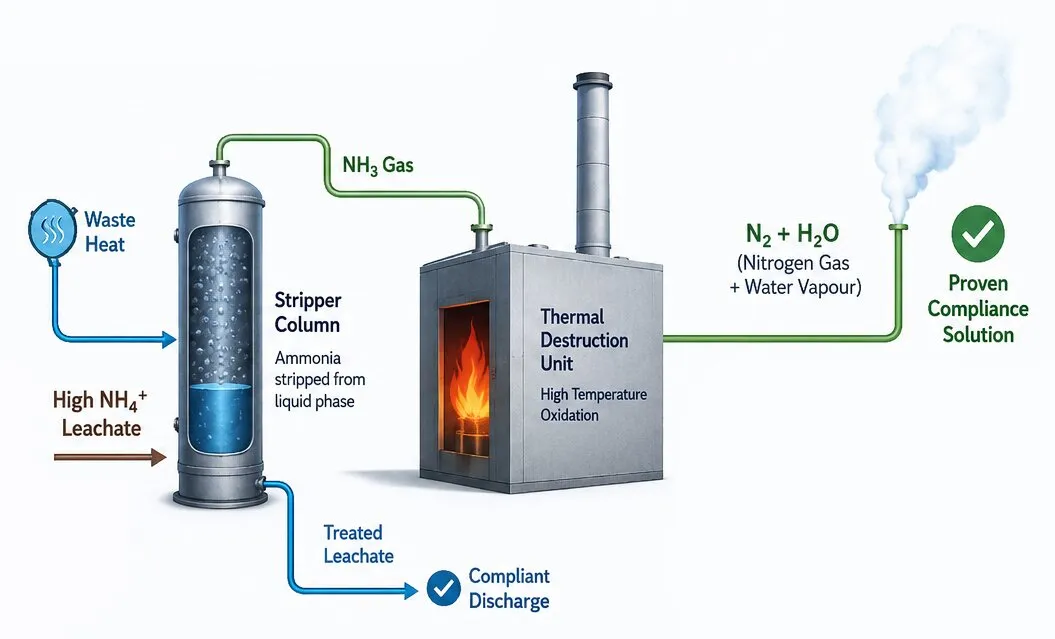
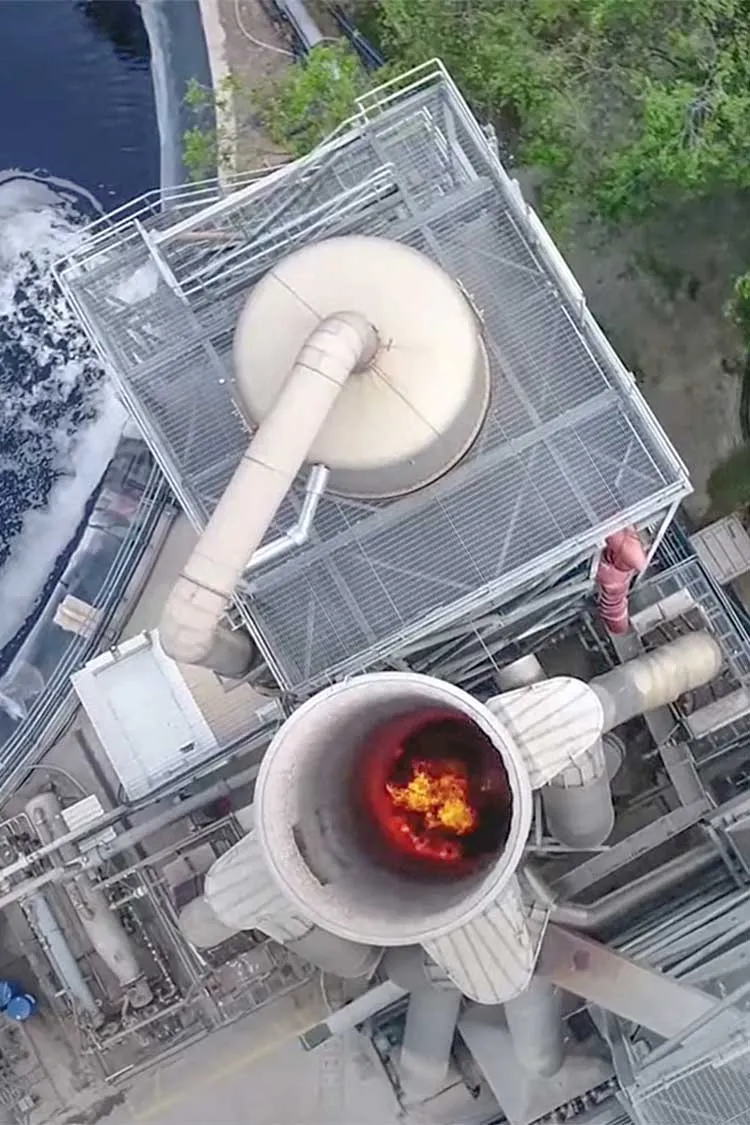
Where ammonia recovery is not practical — either because no product market exists or because chemical handling is undesirable — OTAR uses available waste heat to strip ammonia from the liquid phase and directs the gas to a thermal destruction unit, where it is oxidised at high temperature to nitrogen gas and water vapour.
This is a proven compliance solution. Multiple leachate treatment facilities in Hong Kong adopted this approach, drawing on waste heat from nearby biogas engines and landfill gas to achieve stringent nitrogen discharge compliance without any downstream chemical handling. The trade-off is clear: compliance is achieved but no product revenue is generated
Variant 2
Waste Heat to Recover Ammonium Hydroxide
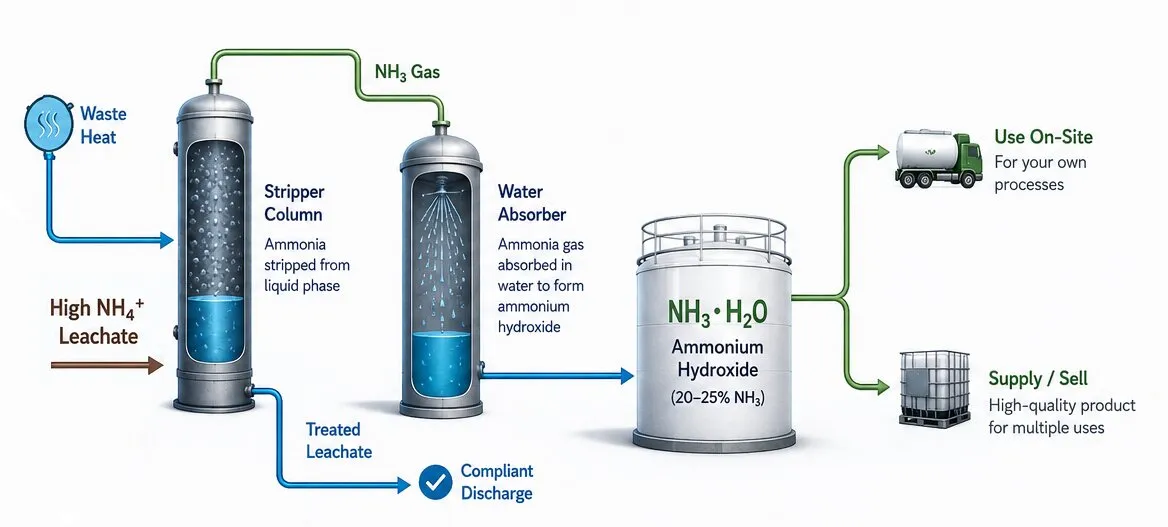
Where product recovery is desired, OTAR Variant 2 uses waste heat to strip ammonia and then absorbs the recovered gas into water, producing ammonium hydroxide (aqueous ammonia, typically 20–25% NH₃). This is the preferred configuration for most UK and European markets.
The process uses no acid and generates no salt waste, making the product eligible for OMRI listing — a certification that conventional acid-absorption systems cannot achieve.
One documented example involves a chemical manufacturing plant that integrated this variant to generate ammonium hydroxide for its own processes, reducing external purchases by nearly a third. With further concentration, the same system can produce anhydrous ammonia for fertiliser, refrigeration or hydrogen carrier applications.
Variant 3
Waste Heat to Recover Ammonium Sulphate
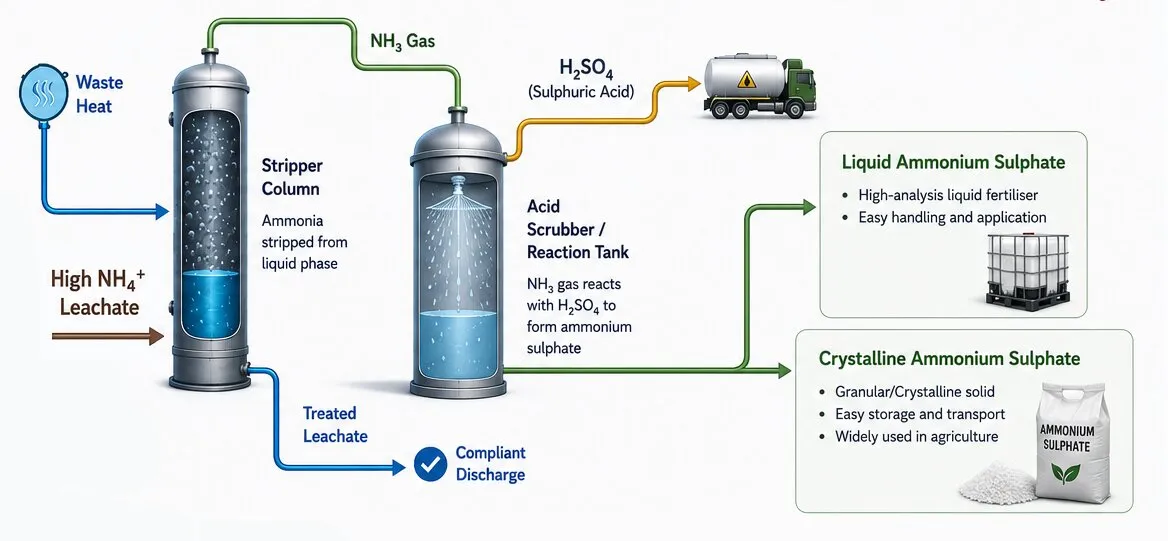
In agricultural regions with strong local demand for sulphate fertiliser, OTAR Variant 3 reacts the stripped ammonia gas with sulphuric acid to produce ammonium sulphate — either as a liquid fertiliser or crystalline solid. This pathway has proven particularly attractive where farming cooperatives can take the product directly and where sulphuric acid is readily available at competitive cost.
The advantage is a stable, widely recognised product with established markets. The challenges are the need for a reliable acid supply chain and the requirement to meet agricultural quality standards. This variant does not produce OMRI-eligible product.
Variant 4
Heat Recycling
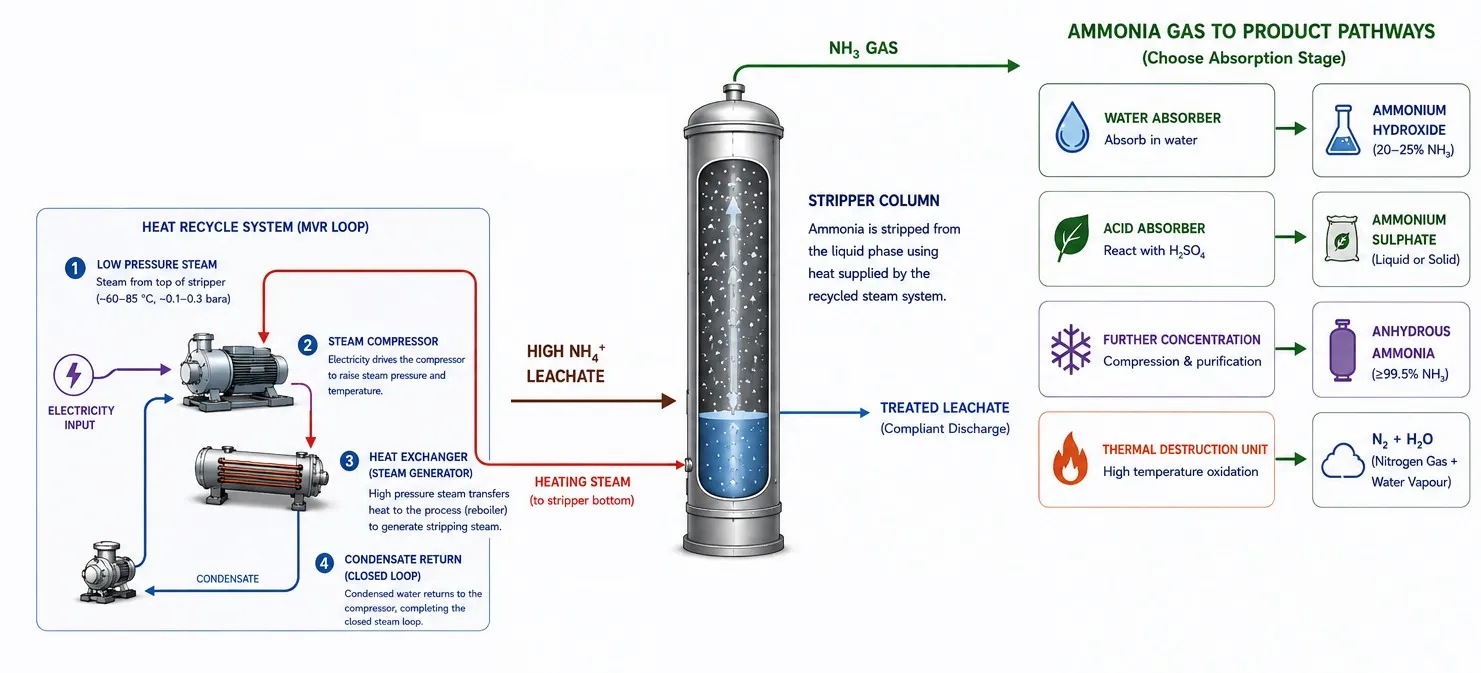
For sites without reliable waste heat, Variant 4 uses electricity to drive a heat recycling system that compresses and recycles steam to generate the thermal energy needed for stripping. The coefficient of performance exceeds 15 — meaning 15 or more units of stripping heat are delivered per unit of electrical energy consumed. This is highly efficient.
Variant 4 is compatible with all product pathways: it can support thermal destruction, ammonium hydroxide production, anhydrous ammonia production or ammonium sulphate generation depending on the absorption stage selected.
It is particularly suited to remote sites, standalone plants, and facilities with fluctuating waste heat availability such as seasonal food processors.
Variant 5
pH-Driven Conversion
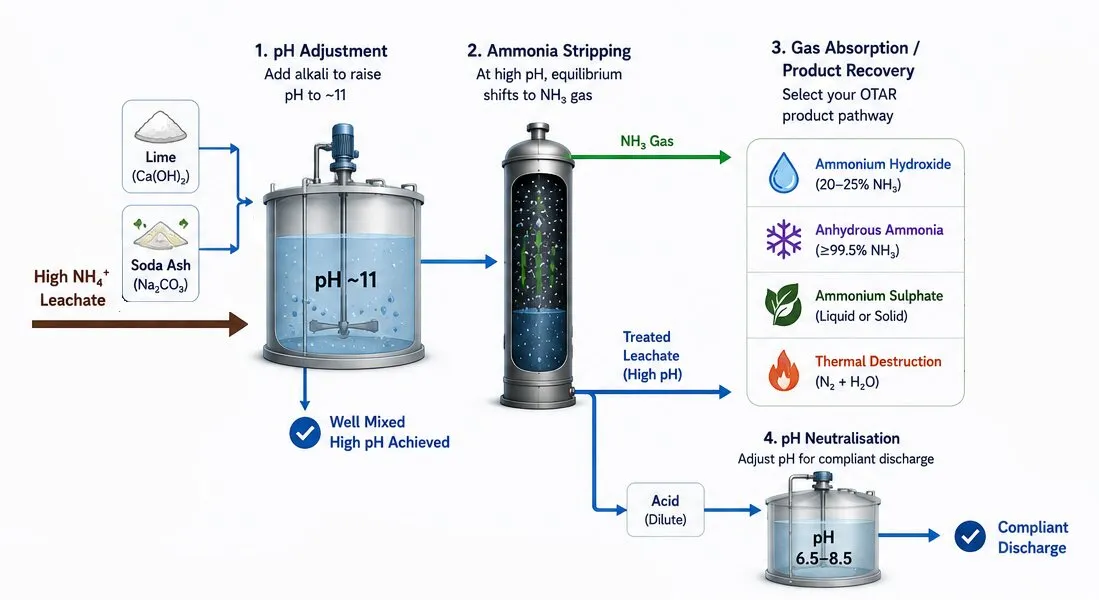
Where waste heat is in short supply, ammonia stripping can be facilitated by raising the pH of the wastewater to around pH 11 using an alkali base such as lime or sodium hydroxide (soda ash). At elevated pH, the equilibrium shifts towards free ammonia gas without requiring high temperatures, enabling stripping at ambient or moderately elevated conditions.
Where some heat is available alongside pH adjustment, the chemical requirement can be proportionally reduced. This variant is fully compatible with all OTAR product recovery routes and is suited to sites where bulk chemical supply is straightforward. The trade-offs are the ongoing alkali cost and the need to adjust pH back after stripping for discharge compliance.